
- Protect Our Coasts From Offshore Oil Drilling – sign the petition
- Protect the Davidson Seamount from Deep Sea Mining – see details below
- Another petition – from Earth Justice
- The Blue Wall – Protection of the Coast by Counties and Cities – see details below

Join Surfrider in Our Effort to Stop Congress From Selling Off More of Our Ocean for New Offshore Oil & Gas Drilling
The Trump administration is currently revising the 5-year offshore drilling plan to bring oil rigs to a coastline near you, ignoring overwhelming public opposition. The Department of Interior will soon release its offshore drilling proposal which is expected to target all major U.S. coasts.
Our Federal leaders must stop new offshore drilling in U.S. waters — please tell Congress to protect our coasts!
Congressional leaders have introduced legislation to permanently ban new offshore oil and gas drilling off the East Coast, West Coast, Eastern Gulf of Mexico and Arctic Ocean. Passing these bills is critical to protecting our marine ecosystems, wildlife, and coastal recreation and tourism across the U.S. petition here .
2. Protect the Davidson Seamount from Deep Sea Mining
This underwater extinct volcano is home to many wonderful special creatures including the dumbo octopus and bubblegum coral. Deep sea mining would threaten these are many other creatures.

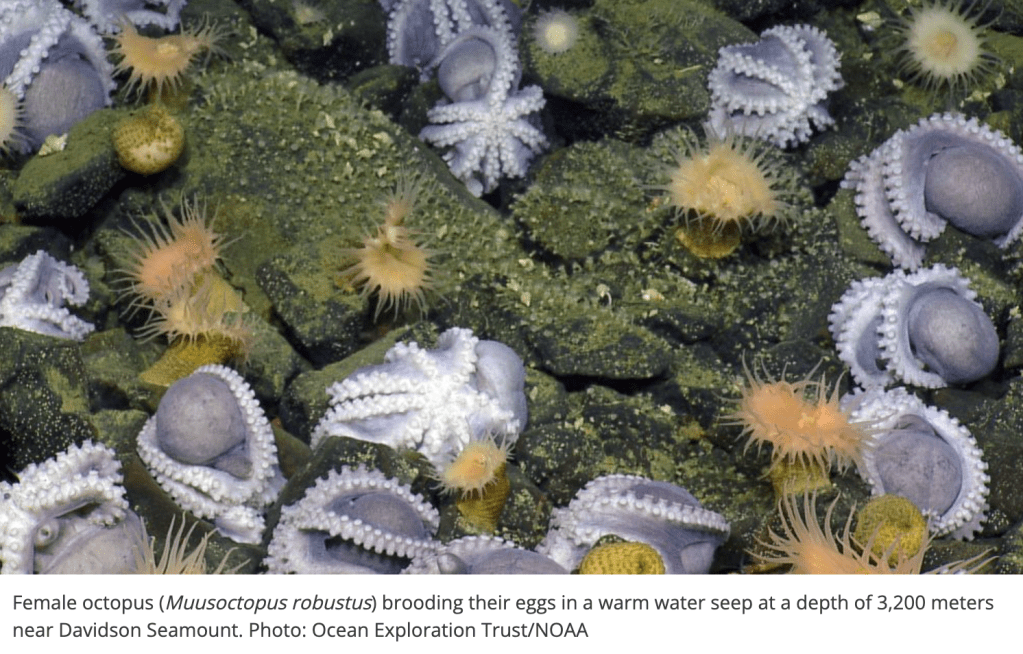
It would also threaten the recently discovered octopus garden where hundreds of female octopi nurture their eggs in warmer water from volcanic vents.
Deep-sea mining risks disrupting the marine food web, study warns
By ALEXA ST. JOHN Updated 2:10 AM PST, November 6, 2025
Drilling for minerals deep in the ocean could have immense consequences for the tiny animals at the core of the vast marine food web — and ultimately affect fisheries and the food we find on our plates, according to a new study.
Deep-sea mining means drilling the seafloor for “polymetallic nodules” loaded with critical minerals including copper, iron, zinc and more. While not yet commercialized, nations are pursuing deep-sea operations amid rising demand for these minerals in electric vehicles and other parts of the energy transition, as well as for technology and military use.The researchers examined water and waste gathered from a deep-sea mining trial in 2022.

Open save panel
3. Petition from Earth Justice
4. Blue Wall Details
The Houston Chronicle obtained leaked documents that the Trump Administration plans new offshore oil drilling off California’s coast, possibly with no environmental review and diminished public input. Presidential executive orders and legislation have also authorized seabed mining for rare earths and precious minerals, with the Bureau of Ocean Energy Management (BOEM) regulating it in US federal waters.
Save Our Shores and Santa Cruz County elected leaders are fighting back:

1) The OCS Local Government Coordination Program, to engage California local governments in opposition to proposed offshore oil development and seabed mining, has been re-invigorated by Santa Cruz County Supervisor Justin Cummings.
2) Save Our Shores (SOS) will update and strengthen the ordinances for the four jurisdictions in Santa Cruz County that prohibit (City of Capitola), or require a vote of the people to approve (Santa Cruz City and County, City of Watsonville) zoning changes to allow the development of onshore facilities that support offshore oil and gas development and add language relative to onshore facilities for seabed mining. Save Our Shores will work with other local governments to update existing ordinances (see map below), and to add new ones, to fortify the blue wall.
This work builds on the 1985-1992 SOS campaign that resulted in the adoption of 26 (a 27th, Marin County, was added in 2020) ordinances starting with the City of Santa Cruz’s Measure A in March, 1985 that received 82% of the vote, which directed the city to use its resources to fight offshore oil. Thirteen communities were sued by the Western Oil and Gas Association to overturn those ordinances, but local governments prevailed.


 Santa Cruz Climate Action Network