Blog

SC CAN Letter Against Oil Drilling etc.


The comment period on the 1st Analysis and Proposal will open on Nov. 24, 2025 for 60 days. HERE IS THE INFO to send your own – as an individual or as a groupGroup letters are especially powerful.

Preferred Method: Regulations.gov Docket ID: BOEM-2025-0483 click comments to submit comments and view other comments. Feel free to use any or all of the sample letter below which was sent on behalf of Santa Cruz Climate Action Network, or write something shorter and simpler.

We are writing in strong opposition to the proposed off-shore drilling and deep sea mining along the Pacific Coast.
The Pacific coast is a scenic treasure drawing hundreds of thousands of visitors each year. More importantly, it is an ecological buffer for marine life and an extraordinary cache for ocean discovery–in the Monterey Bay alone, a new species is discovered from the ocean floor EVERY SINGLE DAY! Both of these benefits would be destroyed by oil rigs and inevitable spills–the likes of those in 2015 and 2021–that killed grey whales, sea otters, pelicans and many other creatures important for the health of the ocean and the entire planet. We have learned through past catastrophes that there is no “safe” oil extraction within our coastal waters!
The economy of coastal cities relies on tourism which would be negatively affected. Oil rigs–however gaily lit–do not contribute to the sense of awe experienced by those visiting the coast and experiencing the vastness of the ocean, the curve of the planet and the breath of clean air.
Coastal wetlands essential to the ecosystem would also be at risk. These areas are necessary for water purification, flood protection, habitat protection and erosion control.
Commercial and recreational fishing would be threatened.
Clean energy is accelerating and already cheaper than oil/gas. Oil supplies are overabundant. By the time these wells would be productive, they would be redundant.
Most coastal counties have ordinances blocking the infrastructure necessary for offshore oil/gas production. This would necessitate significant transportation costs to any such undertakings.
The Pacific Coast has a chain of National Marine Sanctuaries which were specifically established to prevent future oil drilling. Any violation of their protected status would be a crime.

For these reasons, we demand that you not allow these leases to proceed. Be assured that there will be strenuous opposition, costing your agency, and therefore the tax payer, both time and money.

We are a 1950 member strong climate group in Santa Cruz with many powerful allies equally opposed to this ill conceived proposal.


How to Understand Why Atmospheric CO₂ Keeps Increasing

How to Understand Why Atmospheric CO₂ Keeps Increasing Despite Stable Emissions
The complete guide to carbon sinks, residence time, and climate lag effects
Jenny Climate Journalist Nov 20 

So here’s what’s messing with everyone’s heads right now. We keep hearing that worldwide carbon emissions have pretty much plateaued, yeah? Like, the growth rate is sitting at 0.6% per year now, down from a whopping 2% back in the day. Sounds positive, right? Well, buckle up because atmospheric CO₂ concentrations are absolutely soaring at record breaking levels. Between 2023 and 2024, we watched atmospheric CO₂ jump by 3.5 ppm, which is literally the biggest single year jump since scientists started keeping score back in 1957.
You’re probably wondering: “Hold on, how does that even work?”
The answer’s actually simple once you get it: we’ve been conflating two completely separate phenomena, and that confusion is basically why we’re careening toward environmental collapse.
The Water Analogy: Why Your Understanding Has Been Backwards This Whole Time
Picture yourself running a bath. The faucet? That’s carbon emissions, the stuff we’re constantly releasing from fossil fuels and our general recklessness. The drain represents natural carbon sinks, which includes forests, oceans, and soil that pull in CO₂ and lock it away.
Here’s what most people miss: just slowing down the flow from the faucet doesn’t stop the water level from rising. Not a chance.
Consider this: if water keeps pouring out of the faucet at high speed and you’ve only cracked the drain open a bit, the water keeps getting higher. You’re not adding more per unit of time, yet the drain can’t handle what’s already coming through. Welcome to 2024. We’re dumping around 10 gigatons of carbon into our skies annually. Meanwhile, the planet’s natural cleanup systems, which used to absorb roughly a third of what we throw at them, are running on empty.
The Heartbreaking Truth: Our Planet’s Carbon Absorbers Are Failing
This is where things get genuinely bleak.We’ve spent decades leaning on forests and oceans as our planetary custodians. Sure, we knew they were stressed, but we figured they’d just keep soaking up our CO₂ regardless. Turns out that’s not how this works.
During 2023 and 2024, both turned out to be scorching hot years, forests worldwide sucked up only around a third of the carbon dioxide they’d normally absorb in a typical year. Think about that for a second. The planet’s forest carbon sink hit its lowest level in twenty plus years. The culprit? Massive wildfires, specifically Canada’s northern forests torching, Bolivia burning through nearly 1.5 million hectares in a single year (their worst on record), plus enormous fires throughout the southern regions. Forests basically switched from being carbon storage to carbon release machines.
Genuinely apocalyptic energy, honestly.
But there’s additional bad news waiting.
The seas’ capacity to hold carbon? Also crashing. When water temperatures increase, the ocean loses its knack for storing carbon. We’re getting marine heatwaves that are absolutely trashing ecosystems that once served as our strongest protection against warming. And that tundra, you know, that frozen ground that’s been holding carbon for thousands of years? It’s switched roles, now releasing carbon instead of storing it because of fires and thawing permafrost.
Basically… our backup systems are shutting down. One after another.
El Niño: When Everything Goes Wrong Simultaneously
So you recall 2024, yeah? The year that broke temperature records. A major El Niño occurrence bears responsibility for some of that, which is the warm stage of an ocean circulation pattern that cycles every few years or so.
And this is where it gets genuinely crazy: during El Niño periods, the whole carbon system gets completely disrupted.
El Niño brings intense droughts and excessive heat to equatorial regions. Vegetation experiences stress and drying, becoming essentially useless at absorbing CO₂. Plants actually emit carbon back out when they’re parched and struggling. That 2015 to 2016 El Niño? It added around 8.8 billion tonnes of CO₂ into the air as a side effect, comparable to a third of what humans discharge annually. All because of one peculiar weather event.
The El Niño of 2024, combined with extraordinary drought and massive fires hitting the Amazon and southern Africa, resulted in land and water carbon absorption systems performing at diminished levels exactly at the moment we desperately required them operating at peak efficiency. Think of it like your emergency backup generator deciding to malfunction during a critical power outage.
Emissions Output versus Atmospheric CO₂ Presence: Quit Mixing These Up
Alright, straight shooting here. The reason folks are bewildered these days is the media keeps blending these separate ideas together, and frankly, it’s aggravating.
Emissions output = how much CO₂ we’re actively sending skyward at this instant.
Atmospheric CO₂ presence = the amount of CO₂ floating around in our air right now. It encompasses all the stuff we’ve ever released, collecting up like an unpaid bill.
Holding emissions flat doesn’t mean atmospheric CO₂ stops accumulating. It just indicates we’ve decreased the rate of worsening things. Yet we persist in worsening things. Perpetually. And nature’s capacity to eliminate it? Deteriorating annually.
Atmospheric CO₂ averaged 422.8 ppm in 2024, setting a new benchmark. And here’s the sobering bit: Between a fifth and three fifths of CO₂ from burning fuel hangs around for ten centuries minimum, with complete restoration spanning hundreds of millennia. We’re managing not just current releases. We’re managing accumulated carbon from centuries that our environment literally cannot process at sufficient velocity.
The Reason Individual CO₂ Bits Persist for Ages (Despite Brief 5 Year Cycles)
This element genuinely melted my brain the instant I comprehended it, so get ready.
Particular CO₂ particles spend roughly 4 to 5 years drifting through our sky. Seas, living things, and ground capture them relatively fast. However, and I’m talking about a significant however, when they vanish from the sky, they’re essentially swapping positions with CO₂ already submerged in the ocean.
They don’t vanish into oblivion. They simply relocate. The carbon circulation doesn’t annihilate carbon; it just redistributes it. Therefore, while individual atoms are constantly cycling between atmosphere and surroundings, the cumulative quantity of CO₂ everywhere keeps expanding because we’re introducing faster than nature processes.
Visualize it this way: you’ve got a tub (the atmosphere), and it connects to an enormous reservoir (the hydrosphere and biosphere). Individual liquid molecules swap back and forth perpetually. Yet if you continuously pour from an inexhaustible source quicker than it empties, water level ascends, regardless of molecular exchanges.
The atmospheric persistence of CO₂, referring to duration for skies to normalize post elevated CO₂, spans millennia. So yeah. We damaged it. Centuries worth? Nope. Millennia worth.
The Delay: The Environmental Disaster That’s Unavoidable
And man, here’s something else genuinely unsettling that disturbs my sleep.
Suppose we extinguished all emissions instantaneously, completely shut every petroleum operation, shuttered every facility, halted every aircraft, atmospheric CO₂ would persist rising for quite some time anyway. It’s basic physics.
There’s a postponement in the connection between dropping emissions and decreasing atmospheric concentrations. Investigation discovered that despite decreasing output, CO₂ levels show “momentary expansion,” signifying it continues climbing briefly via deferred processes. The research demonstrated that absent rapid emission cuts within approximately ten years, this momentary expansion could itself initiate irreversible climatic change.
No worries though, right?
It indicates the atmospheric warming we’re currently experiencing was fundamentally established ages past. And warming approaching in the next couple of decades? Pretty much baked in, regardless of alterations we implement today. The direction is established. The system has momentum.
Today’s Worldwide CO₂ Saturation Is Exceeding Every Forecast
Allow me to present the sobering statistics:
In 2024, skies averaged 422.8 ppm of CO₂, the maximum documented.
Between 2023 and 2024, levels rose 3.75 ppm, the steepest yearly leap ever documented.
This enormous jump transpired despite worldwide emission expansion being nearly nonexistent (approximately 0.1% growth in 2023).
CO₂ expansion annually has multiplied by three since the nineteen sixties.
The inconsistency is glaring: output is approximately steady, yet atmospheric CO₂ is rapidly climbing. The reason? We’ve passed the threshold where absorption systems cannot match our discharge.
The Escalating Trap: How Warming Intensifies Warming
Plus, because existence apparently savors maximum paradox, this situation feeds itself. Heating deteriorates carbon sinks, prompting extra CO₂ buildup, generating additional heating, which erodes sinks further.
It resembles an endless cycle of catastrophe.
Hotter conditions spark additional combustion → burning releases sequestered carbon → additional CO₂ reaches atmosphere → additional heating → additional combustion. Thermal ocean effects lessen CO₂ retention → extra CO₂ lingers → waterways get hotter → repeating cycle.
The statement from the Marine Biological Association put it directly: “The seas have served as our greatest protector against climate destabilization; proof now confirms that warming and intensifying maritime heat patterns are diminishing the seas’ capacity for carbon retention.
”We’re witnessing planetary defenses crumble moment by moment. And truthfully? It’s terrifying.
What’s the Bottom Line?
So essentially, the true, uncensored summary: keeping emissions at present record highs won’t aid us. Nowhere near.To genuinely shrink atmospheric CO₂, we’d require emissions decreases of around 60 to 80% from today’s levels. Maintaining? Nope. Decelerating expansion? Nope. Slashing significantly. And we require acting quickly enough for organic absorption systems to bounce back and restore themselves rather than deteriorate.
The “postponement” between slashing outputs and atmospheric CO₂ going down? We’re looking at roughly 10 to 15 years until unstoppable warming activates. Beyond that window, regardless of radical emission reductions, anticipate ages of elevated CO₂ and temperature increases.
And the finishing touch? Our absorption systems, those organic procedures we’ve depended on, are eroding when we’re most dependent on them. Vegetation that should sequester carbon ignites. Waters that should minimize warming intensify. The Amazon risks transitioning from storing carbon to generating it.
We’ve essentially weaponized the environment. Fantastic. Absolutely fantastic.The Uncomfortable Reality: Where We Actually Stand
Truthfully, I cannot supply an uplifting conclusion here. Not because I’m seeking drama, but because genuine conditions don’t warrant hopefulness, they necessitate action.
Atmospheric CO₂ accumulation persists upward despite static emissions because:
We maintain discharging carbon quicker than nature eliminates it.
Carbon dioxide endures in skies for ages or longer.
Organic absorption systems are collapsing from environmental stress.
A temporal separation persists between emission reductions and atmospheric CO₂ descent.
Warming erodes carbon absorbing systems, generating self reinforcing cycles.
Maintaining output steady? Resembles decreasing pace on a vehicle already plummeting down a ravine. Might offer seconds longer, yet trajectory stays identical.
We require emission cuts. Dramatic, urgent, constant cuts. Additionally, we must incorporate substantial carbon extraction methods and land restoration as organic sinks require backing. Vegetation requires opportunity to regenerate. Amazon protection is essential before transformation happens. We need severe output reductions to diminish water thermal anomalies.
Is development occurring with adequate velocity? Truthfully? Absolutely not. Nowhere near sufficient.
Yet grasping how atmospheric CO₂ persists climbing despite stable outputs represents progression toward realizing incremental enhancements fall short. Fundamental transformation is needed. Presently.
And when that registers as alarming? Absolutely. It definitely should.

Preserve Our Marine Sanctuary

  1. Protect Our Coasts From Offshore Oil Drillingsign the petition
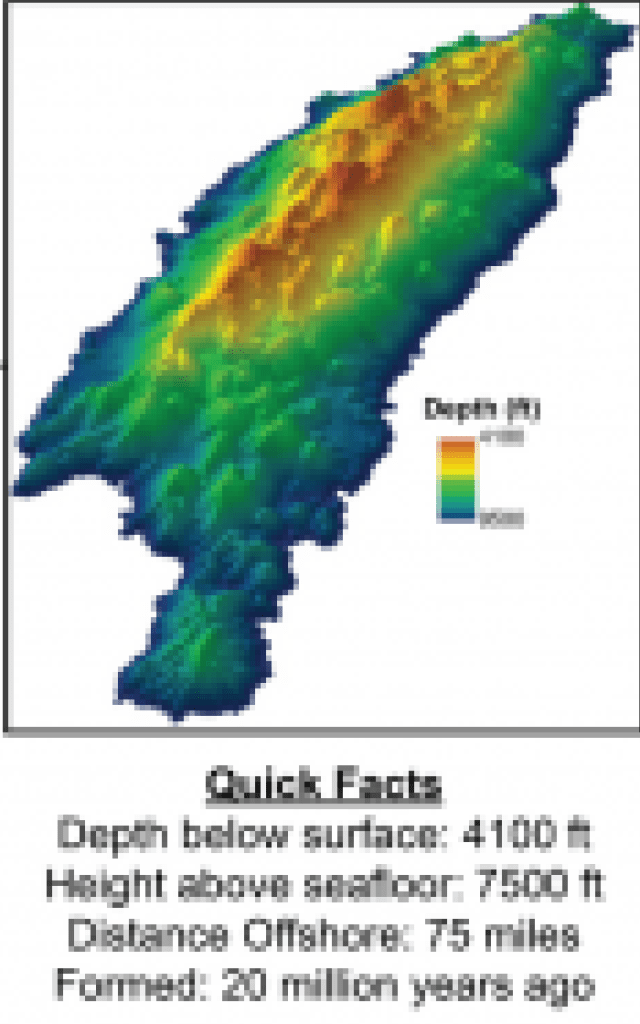
  2. Protect the Davidson Seamount from Deep Sea Miningsee details below
  3. Another petition – from Earth Justice
  4. The Blue Wall – Protection of the Coast by Counties and Cities – see details below
This image has an empty alt attribute; its file name is screoilspll.png

Join Surfrider in Our Effort to Stop Congress From Selling Off More of Our Ocean for New Offshore Oil & Gas Drilling 

The Trump administration is currently revising the 5-year offshore drilling plan to bring oil rigs to a coastline near you, ignoring overwhelming public opposition. The Department of Interior will soon release its offshore drilling proposal which is expected to target all major U.S. coasts. 

Our Federal leaders must stop new offshore drilling in U.S. waters — please tell Congress to protect our coasts!

Congressional leaders have introduced legislation to permanently ban new offshore oil and gas drilling off the East Coast, West Coast, Eastern Gulf of Mexico and Arctic Ocean. Passing these bills is critical to protecting our marine ecosystems, wildlife, and coastal recreation and tourism across the U.S. petition here .

2. Protect the Davidson Seamount from Deep Sea Mining

This underwater extinct volcano is home to many wonderful special creatures including the dumbo octopus and bubblegum coral. Deep sea mining would threaten these are many other creatures.

This image has an empty alt attribute; its file name is bubble-2.png

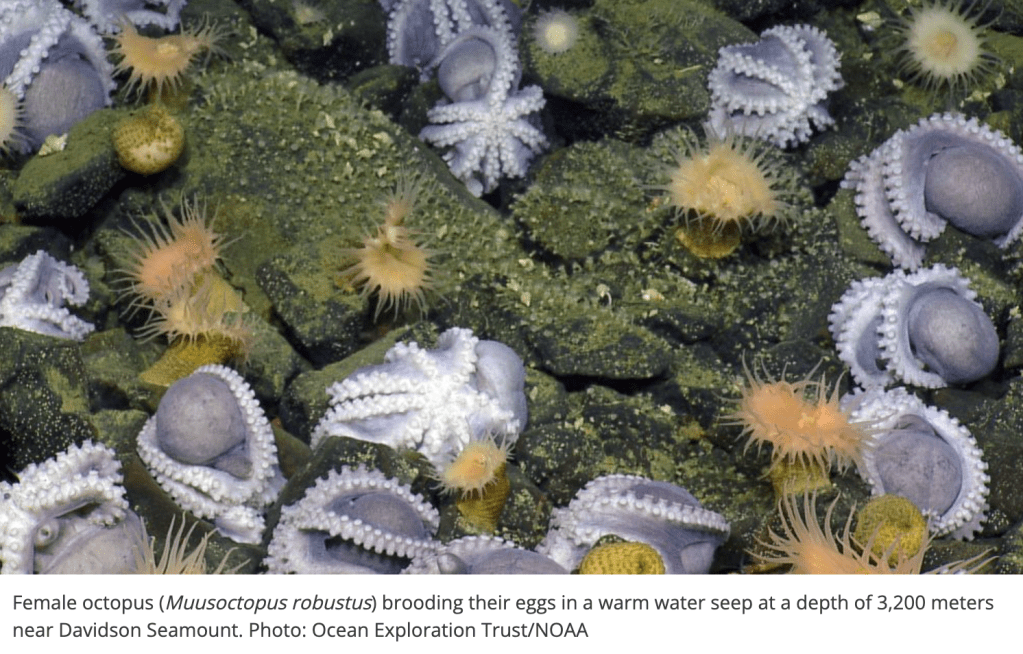
It would also threaten the recently discovered octopus garden where hundreds of female octopi nurture their eggs in warmer water from volcanic vents.

This image has an empty alt attribute; its file name is oct2.png

Deep-sea mining risks disrupting the marine food web, study warns

      By  ALEXA ST. JOHN       Updated 2:10 AM PST, November 6, 2025

Drilling for minerals deep in the ocean could have immense consequences for the tiny animals at the core of the vast marine food web — and ultimately affect fisheries and the food we find on our plates, according to a new study.

Deep-sea mining means drilling the seafloor for “polymetallic nodules” loaded with critical minerals including copper, iron, zinc and more. While not yet commercialized, nations are pursuing deep-sea operations amid rising demand for these minerals in electric vehicles and other parts of the energy transition, as well as for technology and military use.The researchers examined water and waste gathered from a deep-sea mining trial in 2022.

This image has an empty alt attribute; its file name is sanctuarymapcentrca-1.jpg

Open save panel

3. Petition from Earth Justice

4. Blue Wall Details

The Houston Chronicle obtained leaked documents that the Trump Administration plans new offshore oil drilling off California’s coast, possibly with no environmental review and diminished public input. Presidential executive orders and legislation have also authorized seabed mining for rare earths and precious minerals, with the Bureau of Ocean Energy Management (BOEM) regulating it in US federal waters.

Save Our Shores and Santa Cruz County elected leaders are fighting back:

1)      The OCS Local Government Coordination Program, to engage California local governments in opposition to proposed offshore oil development and seabed mining, has been re-invigorated by Santa Cruz County Supervisor Justin Cummings.

2)      Save Our Shores (SOS) will update and strengthen the ordinances for the four jurisdictions in Santa Cruz County that prohibit (City of Capitola), or require a vote of the people to approve (Santa Cruz City and County, City of Watsonville) zoning changes to allow the development of onshore facilities that support offshore oil and gas development and add language relative to onshore facilities for seabed mining. Save Our Shores will work with other local governments to update existing ordinances (see map below), and to add new ones, to fortify the blue wall. 

This work builds on the 1985-1992 SOS campaign that resulted in the adoption of 26 (a 27th, Marin County, was added in 2020) ordinances starting with the City of Santa Cruz’s Measure A in March, 1985 that received 82% of the vote, which directed the city to use its resources to fight offshore oil. Thirteen communities were sued by the Western Oil and Gas Association to overturn those ordinances, but local governments prevailed. 

Preserve Our Marine Sanctuary

  1. Protect Our Coasts From Offshore Oil Drilling
  2. Protect the Davidson Seamount from Deep Sea Mining – see details below
  3. Another Petition – from Earth Justice

Join Surfrider in Our Effort to Stop Congress From Selling Off More of Our Ocean for New Offshore Oil & Gas Drilling 

The Trump administration is currently revising the 5-year offshore drilling plan to bring oil rigs to a coastline near you, ignoring overwhelming public opposition. The Department of Interior will soon release its offshore drilling proposal which is expected to target all major U.S. coasts. 

Our Federal leaders must stop new offshore drilling in U.S. waters — please tell Congress to protect our coasts!

Congressional leaders have introduced legislation to permanently ban new offshore oil and gas drilling off the East Coast, West Coast, Eastern Gulf of Mexico and Arctic Ocean. Passing these bills is critical to protecting our marine ecosystems, wildlife, and coastal recreation and tourism across the U.S. petition here .

2. Protect the Davidson Seamount from Deep Sea Mining

This underwater extinct volcano is home to many wonderful special creatures including the dumbo octopus and bubblegum coral. Deep sea mining would threaten these are many other creatures.

It would also threaten the recently discovered octopus garden where hundreds of female octopi nurture their eggs in warmer water from volcanic vents.

Deep-sea mining risks disrupting the marine food web, study warns

      By  ALEXA ST. JOHN       Updated 2:10 AM PST, November 6, 2025

Drilling for minerals deep in the ocean could have immense consequences for the tiny animals at the core of the vast marine food web — and ultimately affect fisheries and the food we find on our plates, according to a new study.

Deep-sea mining means drilling the seafloor for “polymetallic nodules” loaded with critical minerals including copper, iron, zinc and more. While not yet commercialized, nations are pursuing deep-sea operations amid rising demand for these minerals in electric vehicles and other parts of the energy transition, as well as for technology and military use.The researchers examined water and waste gathered from a deep-sea mining trial in 2022.

Plans to drill for Oil/Gas off the CA coast

Officials speak against offshore drilling By Aric Sleeper

asleeper@santacruzsentinel.com

SANTA CRUZ — Concerned community members, Santa Cruz officials and environmental advocates gathered on the Santa Cruz Wharf on a sunny Wednesday morning to declare their unified opposition to oil and mineral extraction in Monterey Bay and along the Pacific Coast.

“We were here in the 1980s when the federal government threatened to take the California Coast and pollute it, both visually and otherwise, drilling for oil, gas and now, for seabed minerals and they want to do that again,” said Santa Cruz Mayor Fred Keeley. He explained how, in the 1980s, elected officials like state Sen. John Laird and environmental advocates such as former Director of Save Our Shores Dan Haifley, rallied cities and counties in the state to pass local ordinances banning onshore oil support infrastructure without a vote of the people, ultimately creating a “blue wall” along most of the California coast.

“The Monterey Bay National Marine Sanctuary did not get established so a few decades later, they could dot it with oil rigs,” said Keeley. “This is an intergenerational fight because all environmental victories are temporary and all environmental losses are permanent.”

The press conference on the wharf Wednesday comes on the heels of leaked federal documents that revealed the Trump administration’s intentions for the U.S. Department of the Interior’s proposed Five-Year Outer Continental Shelf Oil and Gas Leasing Program, which would potentially allow oil drilling in federal waters along the Pacific and Atlantic coasts, as recently reported by the Houston Chronicle.

What came as a shock to local elected officials and environmental advocates is that the administration is reportedly planning to remove the requirement for an environmental impact review and public comment to speed up the permitting process for offshore drilling projects.

At the gathering on the wharf Wednesday, Rep. Jimmy Panetta discussed how the Trump administration attempted to open up the East and West coasts to resource extraction in his first term through a series of executive orders.

“Fortunately, back then, millions of people got involved. Our state, with leaders like John Laird, got involved and put up legal, logistical and political hurdles, which stalled those proposals and we protected our treasures,” said Panetta. “But Trump 2.0 is a different beast. It’s different because they don’t play by the rules.”

Panetta referenced the recently leaked documents and stressed the importance of letting the Trump administration know that local officials will not stand by and allow oil and mineral extraction along the Central Coast or elsewhere.

“We stand here today to let the administration know that our Monterey Bay National Marine Sanctuary is not the east wing of the White House,” said Panetta.

Laird then outlined the coordinated effort to establish the “blue wall” of cities and counties in the 1980s, Trump’s attempts to allow coastal resource extraction in his first term and his intention to remove environmental review and public comment regarding offshore oil drilling in his current term.

“That’s why we’re here today, is to energize all of you,” said Laird. “And to make sure you know that it’s in your hands now. It’s in your hands to make sure that we educate the public, that we make coalitions in unusual places and that we drive this home. The fight is on and all of you are soldiers in this fight.”

Third District Santa Cruz County Supervisor Justin Cummings pointed out that in the 1980s, then-Third District Supervisor Gary Patton helped to establish the Local Government Outer Continental Shelf Coordination Program to combat oil drilling, and that that coalition was reestablished by order of the Santa Cruz County Board of Supervisors in late June. The coalition is led in part by local nonprofit Save Our Shores.

“So far we’ve reached out to every single representative of every coastal county in the state of California,” said Cummings. “We have been in direct contact with San Mateo, Sonoma, Marin, Humboldt, Monterey, San Luis Obispo, San Diego County and Ventura County, along with the city of Santa Cruz and Santa Barbara, all of whom are in the process of either agendizing or exploring the opportunity to join this effort. And I will say that this is just the beginning.”

The Santa Cruz City Council voted to reaffirm its opposition to offshore oil drilling at a meeting in June and to join with the county’s regional coalition in September. Both actions were championed by Keeley, Councilmember Renee Golder and Vice Mayor Shebreh Kalantari-Johnson, who spoke at the event Wednesday.

“This is about solidarity,” said Kalantari-Johnson. “This is about standing shoulder-to-shoulder, as Congressman Panetta said, and it’s to protect what we know cannot be replaced, so together we will fortify our blue wall.”

After he spoke to the gathering on the wharf, the Sentinel caught up with Haifley, who said the present threat of potential resource extraction along the California Coast is different than it was in the 1980s and 1990s because “this administration is not playing by the rules.”

“This is fundamentally different in that the draft documents that were leaked to the Houston Chronicle indicated that environmental review may be eliminated and that public input may be limited or eliminated. In the 1980s, we were able to organize around those two elements: the environmental impact statement and public comment,” said Haifley. “When that’s been eliminated, that puts the burden of public involvement on local ordinances. We have 27 ordinances, with Marin County adding theirs in 2020, which all need to be updated and we need to add new ones in areas where we didn’t get them before because our momentum slowed down.”

Haifley pointed out that even if conducted adjacent to the Monterey Bay National Marine Sanctuary, “oil spills do not respect sanctuary boundaries,” and that a variety of cascading negative environmental effects in the sanctuary could result from offshore oil drilling and seabed mining.

“We will just have to wait and see what the final plan says,” Haifley said. “Our resolve is to be ready.”

If the Trump administration has its way, oil rigs could soon start drilling along the entire California coast, according to documents obtained by the Houston Chronicle. Drilling could take place in the pristine waters off of Sonoma County and Big Sur, and theoretically even near the Golden Gate, if the administration were to find a way to bypass national marine sanctuary protections. 

California elected officials, environmental organizations, and tourism and fishing industries expressed opposition to the plan, which they’d been expecting and dreading for months. The documents confirmed that the administration plans to open federal waters, which run 3 miles to 200 miles from shore in California, to oil and gas leasing as soon as 2027, according to the Houston Chronicle.  

“This means the oil industry gets open season on the entire California coast,” said Richard Charter, who has worked on the issue for decades and directs a program that coordinates local governments concerned about the impact of offshore leasing on their economies. 

New leases for oil or gas drilling off the California coast have not been granted since 1984, and previous Republican presidents have joined Democrats in protecting the coast from drilling. But this is the second time Trump has attempted to open most of the nation’s waters, including along the California coast, to oil and gas drilling. He did so in 2018 during his first administration but was met with so much opposition that he abandoned it the following year.

Such a move would override federal protections in place for decades and would have to overcome state and local environmental regulations. Many coastal counties have ordinances restricting or prohibiting onshore infrastructure for oil drilling, which would make it all but impossible to bring oil collected in federal waters to shore, experts say. Oil companies would also have to obtain permission from the state Coastal Commission.

“For decades, California has been unwavering in our opposition to new offshore oil and gas drilling. The risk to our economy, coastal communities and public health from new offshore oil and gas development is simply too high,” said Wade Crowfoot, Secretary of California Natural Resources, in a statement. “If the Trump administration chooses to go down this path and sell out our coastal communities to the highest bidder, we will stand firm in our commitment to protecting our coastline and the people of California.”

Because of the obstacles the plan would face, opponents portrayed the move as mostly a political maneuver by President Donald Trump to rile Gov. Gavin Newsom, and the state as a whole.

“This administration is very punitive and wants to threaten California,” said Supervisor Lynda Hopkins of Sonoma County, where onshore oil drilling infrastructure is prohibited. Because of that, she noted oil companies would have difficulty transporting crude oil to refineries, which in the Bay Area are located in Richmond and Martinez. However, she said, “Even if this is very difficult to achieve, we have to take this threat seriously.”

The Chronicle reached out to the White House and did not immediately receive a response.

The administration plans to open Southern California, a federally designated area that stretches from San Diego to Big Sur, to leases in 2027, 2029 and 2030; Central California, which runs north to the Sonoma-Mendocino County border and includes the Bay Area, in 2027 and 2029; and Northern California, which stretches to the Oregon border, in 2029, according to a document obtained by the Houston Chronicle and reviewed by the San Francisco Chronicle.

Oil rigs could also drill off the East Coast for the first time since the 1980s under Trump’s plan, according to the Houston Chronicle — though Florida would keep its ban.

The leaked documents detail the administration’s national oil and gas plan, which it has said is designed to increase the country’s energy independence. The plan is expected to be made public at the end of the month and once released would likely become law two months later, said Charter. If granted, the leases would not likely be revoked by later administrations, he said.

Opponents are concerned that Trump will also target the national marine sanctuaries that run from Point Arena (Mendocino County) to the Channel Islands, where oil drilling is prohibited. Those established after 2008 could be particularly vulnerable, Charter said. 

Newer sanctuaries include one protecting the Davidson Seamount, an underwater volcano off the Big Sur coast, and an extension of the Greater Farallones National Marine Sanctuary, which protects most of the Bay Area coast along with the Monterey Bay National Marine Sanctuary. The newer extension of the Greater Farallones runs between Bodega Head in Sonoma County and Point Arena in Mendocino County.

“The sanctuaries were developed almost specifically to defend against offshore drilling,” said Dick Ogg, a Bodega Bay fisherman who has chilling memories of the ecological damage caused by the Exxon Valdez oil spill in Alaska in 1989. In addition, he’s concerned about the potential ship traffic and losing areas to certain types of fishing, such as long-lining.

“There’s a series of layers of protection in the sanctuaries that create additional impediments to offshore drilling,” Charter said. However, he added, “This administration is unpredictable — they’re tearing down the White House,” referring to Trump’s destruction of the East Wing for a new ballroom.

In 2018, Trump called for a “review” of national marine sanctuaries. 

The areas off the California coast are not very rich in oil resources except for the southern part of the state; farther north, natural gas would be the main objective, Charter said. However, if the leases were first made available in 2027, oil companies could do exploration to see what they find and then take out additional leases in 2029 in Central and Southern California, and again in 2030 in Southern California.

“This plan would put our coasts at risk — we need to protect our coasts from more offshore drilling, not put them up for sale to the oil and gas industry,” said Joseph Gordon, campaign director for the conservation group Oceana, in a statement.

A spill near Huntington Beach in 2021 released approximately 25,000 gallons of oil into the ocean. In 2015, 100,000 gallons of crude spilled from a pipeline carrying offshore oil near Refugio State Beach near Santa Barbara. Both spills had major impacts on wildlife and local businesses.

In July, San Mateo County passed an ordinance conveying its “unwavering opposition” to oil and gas development both offshore and on public lands.

“It’s hard to imagine that anyone would want to damage the national marine sanctuary,” said Ray Mueller, a San Mateo County supervisor who co-sponsored the ordinance.