
11/20/25
| How to Understand Why Atmospheric CO₂ Keeps Increasing Despite Stable Emissions The complete guide to carbon sinks, residence time, and climate lag effects Jenny Climate Journalist This is a sobering review of the current crtical Climate Change situation. It’s written without scientific terms, graphs and equations but it’s very scary. |
11/17/25 Planet in peril: 30 years of climate talks in six charts

By Valerie Volcovici and Richard Valdmanis
10/5/25 Weekly Does of Climate Hope – lots of good stuff around the world
8/11/25 James Hanson “Seeing the Forest for Trees”
James goes into technical details about how the climate is proving to be much more sensitive to increased greenhouse gas emissions than was previously thought – disturbing!
8/11/25 Link to excellent detailed paper on Sulfuryl Fluoride.
Sulfuryl Flouride is one of the “F” gases which cause a noticable amount of global warming due to their extreme heat absorbing capacity also known as Global Warming Potential (GWP)
4/15/25 Newest article from James Hanson – not good news
4/2/25 Global Warming Acceleration: Impact on Sea Ice
2/12/25 More from James Hanson
| Global Warming Has Accelerated. Why? What Are the Consequences?12 February 2025 James Hansen and Pushker Kharecha |
| Once upon a time, Earth Sciences was blessed to have brilliant, articulate, scientific leaders, such as Jule Charney and Francis Bretherton,[1] whose knowledge and overview of climate science commanded respect. And there were many other scientists with deep understanding of the scientific method, who helped spur progress in the field and assure that progress was recognized. Top science writers, such as Walter Sullivan, could rely on such scientific researchers for perceptive descriptions of the major issues and progress in addressing them. We recall fondly learning from Charney’s colleague at MIT, Peter Stone, who served as the principal adviser for climate research at NASA Goddard Institute for Space Studies, back in the days when Charney was trying to decide whether global equilibrium climate sensitivity to doubled atmospheric CO2 was more like 2°C or 4°C. The correct answer would have enormous practical implications. The Intergovernmental Panel on Climate Change (IPCC),[2] set up by the World Meteorological Organization (WMO) and the United Nations Environment Program (UNEP) in 1988, and endorsed by the United Nations that year, produces comprehensive climate assessments about every six or seven years. The reports contain a large amount of useful information; the most recent report on the physical science basis of climate change, the Sixth Assessment Report (IPCC AR6),[3] was published in August 2021. IPCC’s approach to climate analysis came to be dominated by use of global climate models (GCMs) for climate simulations of the past 1-2 centuries. We have taken a complementary approach, placing comparable emphasis on paleoclimate data, GCM modeling, and modern observations of climate processes, as described in our three main papers published in the past decade: (1) “Ice melt, sea level rise and superstorms,”[4] (2) “Global warming in the pipeline,”[5] and (3) “Global warming has accelerated.”[6] The third of these, published last week, was long, as it tied all three together, especially via its Supplementary Material (SM),[7] which usually houses only secondary material. Here is a link to the Abstract + Paper + SM as a single document. Below, we first provide a plain language summary of the three principal conclusions of this paper and then address questions raised in the media by kibitzers. 1. The leap of global temperature in 2023-2024 is explained; no new physics is required. The 0.4°C increase of global temperature in 2023-24 was caused equally by increase of absorbed solar radiation and a weak El Nino. Increase of absorbed sunlight was mainly spurred by reduction of aerosols (tiny particles), especially those emitted by ships, as the International Maritime Organization imposed a strict limit on the sulfur content of ship fuels beginning in 2020.[8] Aerosols serve as cloud formation nuclei; the induced clouds reflect sunlight and cause global cooling that offsets part of the global warming caused by increasing greenhouse gases. This cooling offset has long been described as a “Faustian bargain” because aerosols constitute particulate air pollution that kills millions of people every year. Our Faustian payments – an increase of global warming – come due when we reduce health-damaging air pollution and thus reduce aerosol cooling. 2. Climate sensitivity is 50 percent larger than the best estimate of IPCC. We show that the climate sensitivity required to yield best agreement with observed global warming in the past century is 4.5°C for doubled CO2, which is 50% larger than IPCC’s best estimate of 3°C. Together, conclusions 1 and 2 imply that near-term global temperature will decrease very little: thus, averaged over the El Nino/La Nina cycle, the 1.5°C limit has been reached. IPCC’s estimate of climate sensitivity depended on the assumption that aerosol climate forcing was unchanging during the period 1970-2005, but we show that aerosol forcing increased (became more negative) during that period as aerosols spread more globally, including over pristine ocean areas where their effect is greater. If aerosols were fixed, greenhouse gases are the only forcing and the climate sensitivity required to match observed warming would be about 3°C for doubled CO2. But the net forcing was actually smaller during that period because the negative aerosol forcing was growing, so a larger climate sensitivity is required to match observed warming of the past century. Our estimated climate sensitivity coincides with the sensitivity derived from glacial-to-interglacial climate change, the portion of the paleoclimate record for which precise knowledge of greenhouse gases is available. 3. Accelerated warming increases ice melt and upper ocean warming, threatening to shut down North Atlantic overturning circulation by mid-century and cause large sea level rise. We show that observed ice melt over the past 20 years was similar to assumed ice melt in climate simulations of “Ice Melt, Sea Level Rise, and Superstorms.”4 The rate of ice melt did not increase in the past decade, but, given the leap of global temperature to +1.5°C above preindustrial, we expect ice melt to accelerate, especially in regions such as southeast Greenland where ice melt is injected directly into the Irminger Sea, a region where deepwater forms. The North Atlantic is warming at depths beneath the surface wind-mixed ocean layer, with warmer water penetrating beneath the sea ice and ice shelves. Paleoclimate data suggest that such sub-ice warming can lead to sudden loss of regional sea ice and thus increased warming and summer rainfall on lower reaches of the Greenland ice sheet and increased freshwater injection into the ocean. Our climate simulations4 suggest that such increased ice melt and rapid surface warming can shut down the overturning ocean circulation by mid-century, which would be the “Point of No Return” because shutdown is irreversible in less than centuries. Large sea level rise would become inevitable, as heat normally transported into the North Atlantic would remain in the Southern Hemisphere and speed melting of the West Antarctic ice sheet. Global warming acceleration increases this danger because the increased heating both reduces the density of the upper layer of the ocean and increases the rate of ice melt. |
 |
| Reactions. How would Charney, Bretherton and other scientific leaders of yore have responded to these papers and assertions, and how would the media have responded? It’s a pretty safe bet they would conclude that the papers are a serious analysis. They would think about what observations are needed to confirm and illuminate the issues that are raised. Instead, much reaction in the media seems closer to the continual squealing of farm animals. It is hard to fault the science writers; their stories reflect what they are told by the scientists who are willing or even eager to respond to their inquiries. We find many responses to be unscientific and surprising, given the intergenerational issues that are raised. An illuminating example is the response to Seth Borenstein, the climate science writer for the largest news organization in the world (Associated Press), who was told by 5 of his 6 go-to climate experts that he should not even write about our paper “Ice Melt, Sea Level Rise, and Superstorms;” thus he did not. The paper was also blackballed by the IPCC AR6 report; not a single mention in the several-thousand-page report. Below we speculate about reasons for this treatment, but first let’s respond to current reactions to our “Acceleration” paper. Reaction 1. Feedbacks. It is claimed that we neglect climate feedbacks, which cause most of the warming and cause the largest warming to be in the Southern Hemisphere, not the Northern Hemisphere, where the ship aerosol effect is largest. In fact (see our Fig. 10), the largest sea surface warming is at latitudes 30-50N in the Northern Hemisphere, where ship aerosol forcing is largest. The total ocean heat content gain may be larger in the more massive Southern Hemisphere ocean, but that supports our interpretation. Most increased energy flux into the planet is from climate feedbacks. We evaluated the contributions of forcings and feedbacks that affect Earth’s albedo (Fig. SM15, in the Supplementary Material of our current paper) and energy imbalance. Over the period (since 2000) of precise satellite measurements of Earth’s albedo (reflectivity), Earth has darkened by 1.7 W/m2. Based on the geographical and temporal distribution of the darkening, we infer that about 0.5 W/m2 of this darkening is the ship aerosol forcing. About 0.15 W/m2 is ice/snow albedo feedback, due to reduced sea ice area, which is well-defined. Thus, by subtraction, most of Earth’s darkening must be the cloud feedback that is expected with global warming. It is a huge feedback for the 20-year period with satellite data. If we over-estimated the aerosol forcing, the cloud feedback is even larger. This simple bar graph (Fig. SM15) has another story to tell, which Charney and Bretherton would have recognized instantly: the large cloud feedback in a brief period implies that climate sensitivity is much higher than 3°C for doubled CO2. Charney’s comparison of climate models with 2°C and 4°C sensitivity revealed that a 2°C response is provided by doubled CO2 forcing plus water vapor feedback and small sea ice feedback. Addition of only modest cloud feedback raises the sensitivity to 3°C, as an amplifying feedback enhances all other amplifying feedbacks.[9] Thus, the large cloud feedback in the past two decades provides independent confirmation of high climate sensitivity. Reaction 2. IPCC AR6 models yield realistic global warming acceleration without a ship aerosol effect. The person making this claim – and asserting that it contradicts our conclusions – apparently does not realize that there is a big difference between IPCC’s best estimate for aerosol forcing history and the aerosol forcing in GCMs participating in CMIP6 and IPCC AR6 climate simulations. The IPCC best estimate aerosol forcing is shown in our paper in Fig. 3 and in Figs. 13 and SM1 as updated by Forster et al. (2024). This IPCC aerosol forcing includes the direct aerosol forcing and the larger indirect effect on clouds. This IPCC aerosol forcing is used in the literature for various purposes, e.g., in derivation of an “emergent constraint” on climate sensitivity;[10] these authors assume, consistent with the IPCC aerosol forcing estimate, that aerosol forcing is nearly unchanging over the period 1970-2005. Then, based on observed global warming and assuming that greenhouse gases are the only significant changing forcing in that period, they infer an “emergent constraint” on climate sensitivity: specifically, sensitivity must be close to 3°C for doubled CO2. However, if they allowed the aerosol forcing to change during that period, they would have found quite different results. We showed that there is a one-to-one relation between the climate sensitivity that gives best fit to observed warming and the trend of aerosol forcing in the period 1970-2005: if the aerosol forcing is constant, the sensitivity is ~3°C; if the aerosol forcing increases as in Bauer’s Matrix aerosol model (almost 0.5 W/m2), the sensitivity is ~4.5°C; if the aerosol forcing increases as in Bauer’s OMA aerosol model, the sensitivity is ~6°C (see Figs. 17 and 18). Given this one-to-one relation between climate sensitivity and the aerosol forcing change during 1970-2005, the “emergent constraint” that climate sensitivity is near 3°C amounts to the following: “if we assume that climate sensitivity is near 3°C, we find that climate sensitivity is near 3°C.” For the sake of estimating climate sensitivity, we made climate simulations for 1850-2024 with two free parameters (climate sensitivity and the change of aerosol forcing during 1970-2005) and two constraints (1.6°C global warming between 1850 and 2024, and 0.18°C/decade warming during 1970-2005). The best fit was obtained with sensitivity ~4.5°C for doubled CO2 and an increase of aerosol forcing during 1970-2005 similar to that in Bauer’s Matrix model. After all this explanation, what is wrong with the assertion that CMIP/IPCC models already yield recent acceleration of global warming? Answer: many of the models in the CMIP/IPCC ensemble are not using the IPCC aerosol forcing history. The ensemble includes models that use the Bauer aerosol forcings, e.g., which were steeply increasing during 1970-2005 before stopping growth entirely or even switching to change of the opposite sign. Thus, the average of IPCC models yields global warming acceleration, but it cannot match observed acceleration and the results certainly do not support IPCC’s best estimate for aerosol forcing. Reaction 3. Range of model fog. Another reaction is that observed rapid warming falls in the range of all CMIP/IPCC climate simulations, so there is no basis to question IPCC assumptions. CMIP/IPCC models include the good, the bad, and the ugly. Yet IPCC takes the distribution of model results as a probability distribution for the real world, using this distribution for mathematical analyses that separate IPCC from the possibility of widespread public understanding, much like the Wizard of Oz tried to overpower Dorothy and her friends. For their purpose, a “merit” of the huge range of this model fog is that IPCC will always be “right,” the real world will fall somewhere within that huge fog. Oops! Maybe not. In a paper[11] that perhaps provided the “rationale” for IPCC to blackball our “Ice Melt” paper, 15 authors, representing leading GCM groups, used 21 climate projections from eight “…state-of-the-science, IPCC class…” GCMs to conclude that “…the probability of an AMOC collapse is negligible. This is contrary to a recent modeling study [Hansen et al., 2016] that used a much larger, and in our assessment unrealistic, Northern Hemisphere freshwater forcing… According to our probabilistic assessment, the likelihood of an AMOC collapse remains very small (<1% probability) if global warming is below ~5K… ”. Here, even the range of model results does not seem to encompass all realistic possibilities: few climate experts would assert that 5°C global warming, sufficient to melt most of the ice on the planet, would be unlikely to shut down AMOC (Atlantic Meridional Overturning Circulation). Their models likely obtain AMOC stability only because injection of cold freshwater into the polar oceans in the models is underestimated or based on too-lethargic ice sheet models. Models are essential for understanding ongoing climate change and projections for the future, but by themselves they are inadequate and unable to provide an adequate assessment. The models will be a much more powerful tool, if they are used along with an equally heavy emphasis on paleoclimate data and observations of ongoing climate processes, and the information from all of these combined with mindfulness of climate physics. Reaction 4. We overlooked the role of decreased aerosols from China. The direct radiative effect of aerosol change is shown in clear-sky measurements of the global increase of absorbed solar radiation (Fig. SM8). The global effect of aerosol change in 2020-2023 relative to 2000-2010 is less than 0.1 W/m2, after the effect of changes in sea ice is removed. China may provide a large fraction of that flux change, but even in total this is a small effect. Change of all-sky absorbed solar radiation (Fig.9) is an order of magnitude larger and the temporal and spatial footprint coincides with the ship aerosol change, and clearly not with change of emissions from China, where the largest decrease was in 2005-2015. The spatial and temporal pattern of SST change (Figure 10) further support the dominance of ship aerosols. It is not surprising that the ship aerosols are much more effective; they are emitted into the lower part of the atmosphere in unpolluted ocean skies, where they have the most effect on clouds. Bretherton and Charney would not have been confused about the role of Chinese aerosols, which they would recognize has no effect on our three main conclusions above. (1) most aerosol change in China occurred prior to 2020-2023 (Fig. 13), with negligible effect on the sudden global warming in 2023. (2) Our inference of an increasing global aerosol forcing during 1970-2005 and derivation of 4.5°C climate sensitivity are independent of the source of increased aerosol forcing. (3) Our conclusion that the danger of passing the “point of no return” (AMOC shutdown and large sea level rise) is increased by the accelerated North Atlantic warming is straightforward: the increased heating reduces the density of the upper layer of the ocean and increases the rate of ice melt – conclusions that do not depend on uncertainties about aerosols from China. Reaction 5. Our results are an outlier. When we have answered all the questions, the critics always resort to “they are an outlier,” with results outside those of the “mainstream” climate research community. This is stated in a way that makes it seem that we are unlikely to be right, even when the real world offers ample evidence in support of our conclusions. The media is then forced to go along with the critics because they outnumber us (there are exceptions, e.g., the comprehensive article by Carrington in the Guardian).[12] However, that’s not the way science works. Science does advance as data become available. Eventually this leads to corrections of the mainstream view – some minor, some major. The difficulty in the case of climate change is that slowness to recognize reality is particularly harmful to young people and future generations because of climate’s delayed response and the danger of passing the point of no return, as we emphasized in the video introduction to our paper. One clarification is needed: our statement that “2°C is dead” was qualified with the phrase “unless a miracle occurs.” It is true that we do not expect a miracle, but the qualification should be included. It is also true that 2°C could be avoided via temporary purposeful cooling to reduce the massive geoengineering (geotransformation, if you prefer) that humanity is presently inflicting upon our home planet – but we do not have the knowledge to recommend such action and the public is nowhere near a point of endorsing such action. The closest thing to a miracle that is conceivable soon would be adoption of cost-free carbon fee-and-dividend[13] policy that we have advocated for almost two decades, as required to underlie and unleash the millions of changes needed to move the world as rapidly as practical to carbon-free energy and a declining level of atmospheric greenhouse gases. Presidents Obama and Biden each had the opportunity to initiate such a revenue-neutral action as part of economic actions required to address economic crises early in their administrations. Instead, Obama did little for climate and Biden borrowed massive amounts of money from future generations (via deficit funding) to subsidize already mature (solar and wind) technologies, an approach that spurred inflation and invited a whiplash energy policy response from the competing political party. Summary. How is it that we can be cast as “outliers,” if the real world supports our interpretation of ongoing climate change? In part, we suspect, it is because of the “cottage” industry (quotation marks because it is not a small industry) that has built up in support of IPCC. It’s easy to understand how IPCC went down the track of low climate sensitivity, as early climate models had simple cloud treatments that produced only modest climate feedback. For those low-sensitivity climate models to match observed global warming during the several decades of steady warming since 1970, they required that (unmeasured) aerosol forcing remain almost unchanging in that period. We now have evidence that aerosol forcing was actually increasing (becoming more negative) during that period, which is consistent with paleoclimate evidence that climate sensitivity is high. It is difficult for such a huge industry to change its position, but in the end physics will rule. On a programmatic note: We have long realized that our conclusion that modern nuclear power needs to play an important role in decarbonizing global energy systems limits our ability to obtain public and philanthropic support for CSAS. Now, it seems, this situation is much aggravated by any open discussion that purposeful global cooling may eventually be needed. It’s reminiscent of an analysis once made by JEH’s oldest grandson at age 10: “If we keep doing what we are doing now then the environment will be ruined when the people who are kids now are grownups. And unless we can figure out how to make a time machine that actually works, there will be no way to go back in time to fix it. It’s not fair that the grownups now are ruining the atmosphere for the grownup in the future. Grownups now are scared of nuclear power but they should be scared of what will happen if they keep doing what they’re doing now because we know the ways to use nuclear power safe and we know that using fossil fuels is not safe. It’s very dangerous.” It seems that “grownups,” have now decided that, after tying one arm behind the back of young people (by setting back nuclear R&D several decades; nuclear power has the potential to be our least expensive 24/7 power source, as well as having the smallest environmental footprint), they should also tie their other arm behind their back by prohibiting research on purposeful cooling, in case the grownups screwed up again and did not leave a time machine. The tactics of the kibitzers seem to work on most of the media and some of our prior supporters. Apparently, the kibitzers have learned from politicians that it doesn’t matter if what you say is true or not, and even ad hominem attacks are allowed – if enough people repeat the arguments often enough, they are accepted. Our attitude has usually been that we don’t have time to deal with all the disinformation and also focus on our scientific research – because eventually the truth will come out. The problem with this assumption is that continuation of the United Nations approach is dangerous. The current policy approach, and belief that it can lead to climate stabilization and cooling by mid-century, is inexorably putting young people into an untenable position. We believe that it is important, despite the advice the UN gets from their massive scientific support group, to clarify where the approach of the United Nations Conferences of the Parties is taking young people. We are very grateful to those people who continue to support Climate Science, Awareness and Solutions. |
| [1] Charney and Bretherton, and some of their accomplishments, are described in Sophie’s Planet (in preparation). [2] Intergovernmental Panel on Climate Change [3] IPCC. Climate Change 2021: The Physical Science Basis [Masson-Delmotte V, Zhai P, Pirani A et al. (eds)]. Cambridge and New York: Cambridge University Press, 2021 [4] J. Hansen, M. Sato, P. Hearty et al., “Ice melt, sea level rise and superstorms: evidence from paleoclimate data, climate modeling, and modern observations that 2C global warming is highly dangerous,” Atmos Chem Phys 16 (2016): 3761-812; paper title is that of the submitted paper. [5] J.E. Hansen, M. Sato, L. Simons et al., “Global warming in the pipeline,” Oxford Open Clim. Chan. 3 (1) (2023): doi.org/10.1093/oxfclm/kgad008 [6] J.E. Hansen, P. Kharecha, M. Sato et al., “Global warming has accelerated: are the United Nations and the public well-informed?” Environment: Science and Policy for Sustainable Development, 67(1), 6–44, 2025, https://doi.org/10.1080/00139157.2025.2434494 [7] Supplementary Material: “Global Warming Has Accelerated: Are the United Nations and the Public Well-Informed?” [8] The increase of absorbed solar radiation includes a smaller, but not negligible, boost from the 11-year solar cycle of solar irradiance, which is presently at a maximum. [9] J. Hansen, A. Lacis, D. Rind et al., “Climate sensitivity: analysis of feedback mechanisms,” In: J.E. Hansen, T. Takahashi (eds). AGU Geophysical Monograph 29 Climate Processes and Climate Sensitivity. Washington: American Geophysical Union (1984): 130-63 [10] D. Jiménez-de-la-Cuesta and T. Mauritsen, Emergent constraints on Earth’s transient and equilibrium response to doubled CO2 from post-1970s global warming. Nature Geoscience, 12(11), 902–905, 2019, doi:10.1038/ s41561- 019-0463-y [11] Bakker P, Schmittner A, Lenaerts JTM et al. Fate of the Atlantic Meridional Overturning Circulation: strong decline under continued warming and Greenland melting. Geophy Res Lett 2016;43:12252-60 [12] D. Carrington, “Climate change target of 2C is “dead,” says renowned climate scientist,” Guardian, 4 February 2025. [13] Hansen J. Storms of My Grandchildren. ISBN 978-1-60819-502-2. New York: Bloomsbury, 2009 |
2/6/25 Scary New Article by James Hanson
Review of “Global Warming Has Accelerated” by James Hanson et al Jan/feb2025
This is a long document with lots of scientific technicalities. Below is my humble summary of the major takeaway points. Pauline Seales
1. Climate Change is accelerating. El Niño was not the main cause of high 23/24 temps
a. IPCC underestimated aerosol effects and climate sensitivity.
b. Some of the warming was due to reduced sulfur emissions from ships switching to cleaner fuel.
c. We are headed for 2-3 deg C warming.
2. The two biggest dangers are the slowing of the AMOC (Atlantic Meridional Overturning Circulation) and melting of the West Antarctic ice sheet. – possibly by the middle of this century.
a. AMOC overturning would cause drastic changes in N Europe, N America and globally.
b. Rapid ice sheet melting could cause a very rapid rise in sea level similar to the Eemian period (120,000 years ago) when sea level rose several meters within a century (~10’ or more). The AMOC also overturned.
3. What can we do
a. Cut emissions drastically
b. Implement a carbon price – he prefers “Fee & dividend” to “Cap & trade”
c. Nuclear energy cannot be reestablished quickly but could help.
d. SRM – sunlight blocking methods need to be considered and evaluated carefully.
4. He refers many times to Fig 15. It shows that while emissions have flattened, they are still close to the catastrophic RCP 8.5 trajectory, and not remotely close to the RCP 2.6 to keep global warming below 2 deg C
Figure 15. Annual growth of greenhouse gas forcing and various IPCC climate forcing scenarios. Footnote72

1/30/25 Climate Change and LA Fires
Human-induced planetary warming made the weather conditions that caused the Los Angeles fires 35% more probable, according to a report published on Tuesday by the research organization World Weather Attribution.The report from WWA, which performs attribution studies that examine how the climate emergency impacts extreme weather events, further fleshes out the public understanding of wildfires that broke out in and around the Los Angeles region in early January. Those fires collectively burned tens of thousands of acres of land, killed 28 people, and destroyed more then 16,000 structures, according to the California Department of Forestry and Fire Protection.1/9/25 Information on Green Concrete
12/9/24 James Hansen presentation at the International Court
11/5/24 Good 15 min Video about Methane – BAD NEWS!!
10/25/24 Good News about electrifying manufacturing using PV and batteries.
10/25/24 Scary News about the Ocean Conveyor
10/21/24 Scary New Report – The 2024 state of the climate report
starts with this: “We are on the brink of an irreversible climate disaster. This is a global emergency beyond any doubt. Much of the very fabric of life on Earth is imperiled. “
10/02/24 Opinion Essay about Hurricane Helene
Good recent article from Inside Climate News
9/23/24 Detailed study of temperATURE AND CLIMATE OVER THE PAST 485 million years
Here’s Bill McKibbens comment “As a new study once more makes clear, raising the temperature is by far the biggest thing humans have ever done; our effort to limit that rise must be just as large.”

9/16/24 The tipping points of climate change — and where we stand ted talk
8/14/24 New Tool From Climate Central Shows details of Ocean temperature Changes
It relates this to hurricanes and other storms and gives a probability of climate change cause.
8/6/24 Future Climate Change by Location
New ap shows how the climate will change for your location. Just click on the map to see details. You can also choose to see how reducing emissions will be a huge help. Works for multiple world wide locations. https://fitzlab.shinyapps.io/cityapp/
3/26/24 Climate Summary lists good and Bad News
3/5/24 Good News on CO2 removal
But it’s NOT Direct Air Capture (DAC) it’s from sea water!
2/24/24 Possible AMOC disruption
details in this article about concerns
1/12/24 James Hansen – Global Warming Acceleration: Causes and Consequences
Considering the large planetary energy imbalance, it will be clear that the world is passing through the 1.5°C ceiling, and is headed much higher, unless steps are taken to affect Earth’s energy imbalance.
1/12/24 A Minnesota Utility Is Swapping Coal for Solar
1/10/24 A huge battery has replaced Hawaii’s last coal plant
1/7/24 Detailed MIT article on reduced emission cement
1/5/24 January Article by Jim Hanson includes

1/5/24 Positive Review of Batteries by Bill McKibben
12/18/23 Lithium extraction from California’s Salton Sea
12/14/23 Great Presentation update from DRAWDOWN
12/14/23 Cop 28 Detailed review by The Carbon Brief
12/14/23 Climate Acceleration update by Jim Hansen
includes this graphic

Posted 12/5/23 James Hansen interviewed by Beckwith
Very interesting and scary – accelerating increases?
10/13/23 El Nino Fizzles. Planet Earth Sizzles. Why?
Newest Climate analysis from Jim Hansen
10/11/23 Big Climate Targets for ireland
Good climate news: the Irish government has adopted a suite of big-deal climate targets! Last summer, Ireland’s longtime rival parties joined forces to govern together. One of them was the Green Party—and as a result, they’ve committed to go carbon neutral by 2050 and to ban gas vehicles by the end of the decade!
10/7/23 Europe Just Launched the worlds’s first Carbon Tariff
Read the article here
10/7/23 Pope Adresses Climate Change and Rich Country Responsibilities
| He specifically takes aim at citizens of richer countries and the “irresponsible lifestyle” of the developed world. |
| “If we consider that emissions per individual in the United States are about two times greater than those of individuals living in China, and about seven times greater than the average of the poorest countries, we can state that a broad change in the irresponsible lifestyle connected with the Western model would have a significant long-term impact.” |
9/18/23 California Sues Giant Oil Companies, Citing Decades of Deception
Launching one of the most prominent climate lawsuits in the nation, the state claims Exxon, Shell, BP and others misled the public and seeks creation of a special fund to pay for recovery. More at this link
9/18/23 75,000 people just marched in NYC, 600,000 around the world to End Fossil Fuels
Pictures:


8/8/23 The Guardian, July 25: The Gulf Stream system could collapse as soon as 2025, a new study suggests.
The shutting down of the vital ocean currents, called the Atlantic Meridional Overturning Circulation (AMOC), would bring catastrophic climate impacts. AMOC was already known to be at its weakest in 1,600 years owing to global heating. Researchers spotted warning signs of a tipping point in 2021. A collapse of AMOC would have disastrous consequences around the world, severely disrupting the rains that billions of people depend on for food in India, South America and west Africa. It would increase storms and drop temperatures dramatically in Europe. (AMOC keeps Europe relatively warm compared to other areas at the same latitude, e.g., Canada) More DETAIL.

5/7/23 Summary of great report by Warheads to Windmills

4/20/23 Great new page on Atmospheric Rivers from Climate Central
4/15/23 Greenhouse gases continued to increase rapidly in 2022 – Detailed NOAA article with graphs
3/21/23 Dangerous Increases in Ocean Heat – short Video
3/17/23/ Link to help Pajaro Flood Victims
3/20/23 The Richest AMericans are Super Polluters

3/14/23 It’s not just California
This report shows many other world areas. Drought and deluge: Scientists have long warned that global warming could lead to wetter and drier extremes. These graphics show where it may already be happening.
1/11/23 The Last 8 Years Were the Hottest on Record – NY Times article
1/5/23 Local storm Damage to West Cliff Santa Cruz
for updates on city plans for traffic go here


12/16/11 New Graphic showing temperature Increases

11/28/22
Annals of a Warming Planet – CLIMATE CHANGE FROM A TO Z
The stories we tell ourselves about the future.by Elizabeth Kolbert. Excellent update by this great writer who has specialized in Climate Change
8/11/22 IRA Bill
Despite its flaws we are happy that the Climate (Inflation Reduction Act bill has passed. There is an excellent review of the good (and not so good) features in this video of an EnRoads Webinar. And here are the workshop slides
8/15/22 -Ksqd interview by matilde Rand
She discussed the IRA bill with Roland Saher and Pauline Seales
7/14/22 Disturbing video debunking “Net Zero”
Shows the woeful inadequacy of current trends. It’s worth watching the whole video – less than 5 mins
5/16/22 Latest Newsletter by James Hansen
Titled “Hotter Hotspots, Drier Dryspots, Wetter Wetspots, and Stronger Storms” this is not good news.

5/12/22 Permafrost thaw is threatening Arctic communities and our global climate.
Depressing article – We need urgent action.
5/6/22 Interesting details on Carbon removal methods
From Yale Climate Connections
4/29/22 Panel on Direct Air Capture
4/29/22 “What’s Happening with the Climate”
Includes bad news and good news
3/8/22 Climate Change is Shifting Spring
New details from Climate Central
12/24/21 Don’t Look Up
Excellent satirical movie highlighting the ridiculousness of governments lack of adequate Climate Action. Available on Netflix
12/11/21 Deadly Tornado in Kentucky NYTimes video
Tornadoes in December are extremely rare and this was was both extremely strong and lone lasting and deadly. Link
12/17/21 Scary review by Bill McKibben – A Summer that really scared scientists

Devastating flooding in British Columbia by an “Atmospheric River” Nov 15, 2021
This article includes several short videos and the science of “Atmospheric Rivers”
11/1/21 How Much Are Countries Pledging to Reduce Emissions?
Follow up to article below with breakout info for various countries –
10/25/21 Great interactive graph showing the need for rapid change
9/29/21 THE “GREENLAND CONNECTION
Great article with a good short video includes explanation about why sea level rise is much worse on the East Coast of the USA than California.
8/15/21 Newest Piece by James Hansen
Not good news !
8/11/21 Interactive graphic about changes in Atlantic ocean circulation
Interesting details on the Gulf stream (AMOC) and possible changes in it’s flow affecting weather in many areas
8/9/21 CO2 removal by crushed basalt
Interesting article in Physics World
7/12/21 Off Shore Wind for Ca
Detailed article includes that the turbines will be 20 or more miles off shore
6/12/21 Change in Seasons
Fascinating graphic from the American Geophysics Union showing how seasons have already changed and will have a massive shift by 2100 unless we drastically reduce emissions and remove CO2 from the atmosphere.
https://phys.org/news/2021-03-northern-hemisphere-summers-year.html?
Carbon Dioxide, Which Drives Climate Change, Reaches Highest Level In 4 Million Years. More details in this NPR article
5/27/21
As climate change progresses by droughts and floods will become more intense. For CA droughts and wildfires are a huge problem. Here’s a link to an interactive drought map.
4/22/21 Climate Clock
Compelling graphic – check it out
Alaskan Glacier Now 100x faster
4/14/21 Interesting animation of the Mt Denali glacier speeding up hugely
MIcro Grid News
3/16/21 Link sent out by Jim Hanson
| City of Camarillo approves moving forward with designs for Hybrid Solar Microgrids at five critical community facilities |
| Following favorable feasibility results, Clean Coalition is awarded a contract to manage the design work for the five sites |
| CAMARILLO, CA — On 10 March 2021, the Camarillo City Council unanimously awarded the Clean Coalition a contract to manage design work for Hybrid Solar Microgrids at five City facilities: City Hall, Police Station, Camarillo Library, Wastewater Treatment Plant, and Corporation Yard. The projects are designed to achieve zero net energy over their anticipated 30-year life and will reduce the cumulative carbon footprint of the five sites by approximately 88 percent. The City previously approved moving forward on the Hybrid Solar Microgrids in November 2020, after the Clean Coalition conducted a solar+storage microgrid feasibility study for the sites with TRC Companies as a subcontractor. |
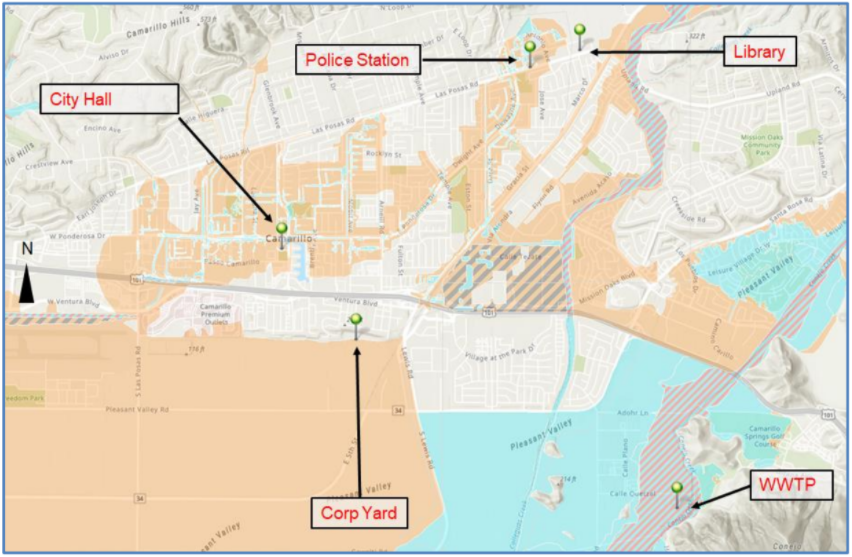 |
| Five Hybrid Solar Microgrid sites in Camarillo. |
| The Solar & Storage Microgrid Feasibility Study, available on the City’s website, found that the most feasible and economic solutions would be hybrid systems that incorporate solar, storage, and at the City Hall, Corporation Yard, Police Station, and Wastewater Treatment Plant, a diesel generator. The Hybrid Solar Microgrids will keep those four sites online during multi-day outages, with diesel generators reserved for use only when needed during extended outages. A pure Solar Microgrid, without any diesel, was recommended for the fifth site, the Camarillo Public Library, which does not need to be kept online during an extended power outage but can benefit from solar+storage backup, as available. Of course, all sites are anticipated to enjoy substantial utility bill savings from daily solar generation — and from using the storage to time-shift solar and optimize economic value through time-of-use (TOU) arbitrage and demand charge management (DCM). The next phase of this project involves the Clean Coalition beginning the design work for the Hybrid Solar Microgrids, with TRC again assisting as a subcontractor. Designs are expected to be completed by the end of July 2021. The City is considering two major options for funding the Hybrid Solar Microgrids. One option is grant funding. The City is pursuing a nationwide grant opportunity from the Federal Emergency Management Agency (FEMA) of up to $50 million per applicant for projects such as microgrids that mitigate risks from natural disasters. Another option for the City is to enter into a power purchase agreement (PPA) with a third-party developer who would build, own, and operate the Hybrid Solar Microgrids. The developer would be selected via a request for proposals (RFP) process. The microgrids are designed to yield utility bill savings at all five facilities. In addition to bill savings, the microgrids will bring the City significant resilience benefits, which the Clean Coalition can quantify using the organization’s straightforward value-of-resilience methodology, VOR123. Recent power outages caused by severe weather across the country have highlighted the need for resilience, a key benefit of Solar Microgrids — which also bring communities significant economic and environmental benefits. “This Hybrid Solar Microgrid project is an excellent example of how the City of Camarillo continues to pursue sustainable efforts that are cost effective, aligning with the City Council Goals & Objectives for Environment/Resource Management,” said Greg Ramirez, Camarillo City Manager. “We are excited to be working with the Clean Coalition to take the next step on these innovative projects.” “By voting to move forward with designs for these hybrid systems, the City of Camarillo has continued to demonstrate significant leadership,” said Frank Wasko, Managing Director of the Clean Coalition. “The Hybrid Solar Microgrids will bring the City unparalleled economic, environmental, and resilience benefits.” |
How Do Countries’ New Emissions-reduction Plans Stack Up?
Thorough review from the World Resources Institute states that a new UN report finds that countries’ emissions-reduction commitments under the Paris Agreement are falling far short of what’s needed to prevent the most dangerous impacts of climate change.
Encouraging Interview with Gina Mcarthy – mar 2021
Biden’s climate chief Gina McCarthy on mobilizing “armies of people” to cut emissions. In an interview with Vox, McCarthy explains what it will take to marshal the power of the federal government on climate.
New Climate Change Maps of the USA

Excellent detailed article including several aspects of Climate Change: Extreme Heat and Humidity, Large Wildfires, Sea Level Rise, Farm Crop Yields, Economic Damages.
It also combines these risks for every county.
Atmospheric Rivers
Interesting article by local UCSC professor Gary Griggs in the Santa Cruz Sentinel Sunday Feb 14, 2021.

Extract:
Two meteorologists have recently documented that our California rainy season is beginning about a month later than it did 60 years ago and it is shorter, meaning more intense rainstorms. This is not something that might happen in the future, however, it’s happening now. With ocean warming, evaporation rates increase. As the atmosphere warms, it can hold more moisture, which means heavier rainfall can be expected in the future.
=======================================================
Climate Change Performance Index 2021
This is good news/bad news : The USA is doing very badly but the rest of the world is doing much better. Excellent detailed document linked below. On the Overall ranking the USA ranks last at #61, China is in the middle at #33 and Sweden ranks highest at #4 (no country was good enough to rank 1,2,3) published Dec 2020
Climate Change Performance Index (CCPI) 2021 | Climate Change Performance Index
=========================================================
The US Climate Fair Share – dec 2020
detailed report here
Infographic below


How America was Misled on Climate Change – published October 2019
Latest Yale survey on how American view Climate Change
| Sophie’s Planet #1: Preface and Chapter 106 April 2020 James Hansen |
| Thanks to the Coronavirus, five trips are canceled. Now I can really finish Sophie’s Planet, which is a story of how I learned the scientific method and of the implications that science has for policies needed to assure a bright future for young people and nature. I will send out draft chapters for fact checking. If you are locked away, need something to read, let me know if you find any flaws. Here is the Preface plus Chapter 1. I opened a Twitter account @DrJamesEHansen, (https://twitter.com/drjamesehansen), but will minimize interactions until the book is finished. The Coronavirus and human-caused climate change are both characterized by a delayed response which makes the problem and its solution more difficult. With the virus the delay time is of order weeks; with climate change the delay is of order generations. In both cases, by the time the effects become obvious, there is a much larger response “in the pipeline.” With the virus the lags for an individual are between infection, appearance of symptoms, and ultimate response, which can potentially include death. The lag for spread of the virus is a bit longer, but it is still measured in weeks. With climate change the lags are between emissions, appearance of warming, and ultimate effects such as large sea level rise and species extinctions, which can potentially lead to social disorder and a more desolate world. We are in a race to find remedies in both cases, but the near-term focus on the virus provides a moment to assess the actions needed for climate. It is a solvable problem. It is inappropriate to pile stress on young people, by implying that it is too late for realistic actions to be effective. It is also wrong science. The climate problem is solvable with actions that make sense for other reasons, and the solution will yield a planet less susceptible to pandemics. |
Great new interactive resource from Climate Central showing many different changes graphable for many cities in each state
California Democrats want their own Green New Deal to fight homelessness, climate change. 1/7/20
Interesting article about current science expeditions to the rapidly melting Thwaites Glacier in West Antarctica 12/29/19
METHANE EMISSIONS REVEALED – Special camera shows methane leakages from a a large number of natural gas facilities posted 12/15/19
Democracy Now video of Great Thunberg in Madrid at COP25, Dec 2019
New article by James Hansen includes new simple graphs comparing major emitters. 12/5/19

A new way to remove CO2 from the air. Will be great if they can make it cheap enough and safely store the CO2 removed. Added 10/25/19
IPCC 2019 publication on The Ocean and Cryosphere in a Changing Climate
IPCC 2019 on Climate Change and Land
Video about the potential Carbon removal technique called Iron Salt Aerosols. Might be great but should be investigated cautiously. 27 minute youtube. https://www.youtube.com/watch?v=Ri0T3KZ0pYM – added 10/12/19
|
|||||||||||||


Report on record breaking temperatures in June 2019 especially in Europe
As the East prepares for record heat waves here is a new video explaining how the recent unusual weather in the US relates to Climate Change. 7/19/19

More scary news from Greenland this week –Details here
6/18/19
Neo Carbon Renewables analysis 6/18/19
A complex analysis of future renewable energy systems eliminating fossil fuels. An excellent simulation of hourly electricity demands with details for many world-wide regions.
Permafrost Problems 6/14/19
A good new video by Peter Sinclair in the “This is Not Cool” series covers melting permafrost problems. Includes new scientific and government publications of interest to climate activists.
Call for Drastic Action in the Arctic News 6/14/19
Record floods devastate Nebraska – spring 2019
Excellent graphical visualization of world wide Climate Crises 3/7/19
It will open in a separate window. Read the text and go down to the world map. I used my cursor from the bottom moving up to display month by month.
Good 4 min video by Bill Nye 3/14/19
National Geographic article on Climate Change3/14/19
Link to Blog post about Massive hole in Antarctic Ice Sheet 2/4/19
Excellent new short video from Years Project
To join the Extinction Rebellion click here Dec 16, 2018.
Excellent BBC summary of COP 24 in Poland. If you don’t feel like reading the text at least check out the graphics by clicking here or Climate change: Where we are in seven chartsDec 16, 2018
Good article on lifestyle changes with an excellent graphic. I’ve enlarged the graphic for tabling. Dec 8, 2018
Excellent long article by Bill MckibbenNov 18, 2018
Video about Extinction Revolution Nov 18, 2018
New Financial Alternative to help Climate Change Oct 14, 2018,
The City adopted a Climate Adaptation Plan Oct 9, 2018,
www.cityofsantacruz.com/home/showdocument?id+23644
New IPCC report on Climate Change Oct 8, 2018
Discouraging new report on “De-carbonization” efforts around the world. We need to really get onto this RIGHT NOW Oct 6, 2018
Senate Bill 100
- SACRAMENTO – Reaffirming California’s global climate leadership, Governor Edmund G. Brown Jr. today signed Senate Bill 100, authored by Senate President pro Tempore Emeritus Kevin de León, setting a 100 percent clean electricity goal for the state, and issued an executive order establishing a new target to achieve carbon neutrality – both by 2045.
“This bill and the executive order put California on a path to meet the goals of Paris and beyond. It will not be easy. It will not be immediate. But it must be done,” said Governor Brown.
“In California, Democrats and Republicans know climate change is real, it’s affecting our lives right now, and unless we take action immediately – it may become irreversible,” said Senator de León. “Today, with Governor Brown’s support, California sent a message to the rest of the world that we are taking the future into our own hands; refusing to be the victims of its uncertainty. Transitioning to an entirely carbon-free energy grid will create good-paying jobs, ensure our children breathe cleaner air and mitigate the devastating impacts of climate change on our communities and economy.”
This is great news. Santa Cruz is already in a good clean energy position with its new Monterey Bay Community Power, but the executive order will require seriously addressing transportation emissions, which are the biggest contributing factor to climate change locally. Sep 10 , 2018
2. The state released its 4th Climate Assessment report August 27th. There are statewide and central coast reports each over 100 pages. The “Key Findings” (0verview) can be reviewed in less than 5 minutes. Link to our Oct 25th event
http://www.climateassessment.ca.gov/state/overview/
http://www.climateassessment.ca.gov/state/index.html
Tomorrow Movie – of you missed the 2 local screenings you can watch it on amazon from $3.99 Tomorrow website- Tomorrow
UN 2017 report This is worth reading in detail as it gives information about serious world-wide efforts.
SeaLevel Rise Hot House Earth pages with lots of info
 Santa Cruz Climate Action Network